The
intensive
mixer.
The original Eirich machine. A rotating pan, an eccentric tool, two independent drives, an optional vacuum hood. Every recipe Eirich runs, from a 0.1 litre laboratory trial to a 12,000 litre production batch, sits inside this geometry.
The principle
in four
movements.
The intensive mixer is not a stirrer with extra features. It is a closed system of four motions, each independently adjustable, each tuned per recipe.
The rotating pan
An inclined pan carries the entire batch in one direction at a tunable 5 to 50 rpm. The whole charge passes the tool on every revolution.
The eccentric tool
A mixing tool sits off centre and rotates against the pan. Tip speeds reach 40 metres per second, but only where the geometry asks for it.
Independent drives
Pan and tool run on separate motors. Energy input is decoupled from throughput, so a recipe is tuned in joules, not in guesswork.
Vacuum and temperature
An optional sealed pan reaches 10 mbar and accepts heating or cooling. Drying, degassing and reactive mixing run inside the same machine.
Numbers
carefully set.
Pan, tool, drive and cycle scaled across four size classes. Final figures depend on the recipe and the chosen variant. The Hardheim Technikum confirms them on your real material.
Five
geometries.
- 01
Standard
Fixed pan, top loaded, bottom discharge gate. The reference geometry behind every other variant.
- 02
Hinged
The mixing head pivots clear of the pan for fast cleaning, recipe changes and visual inspection.
- 03
Tilting
The pan tilts to discharge by gravity. Right for sticky pastes, friction linings, carbon and refractory bodies.
- 04
MixSolver
Dissolving and dispersing variant. High shear tool geometry for slurries, paints and battery slips.
- 05
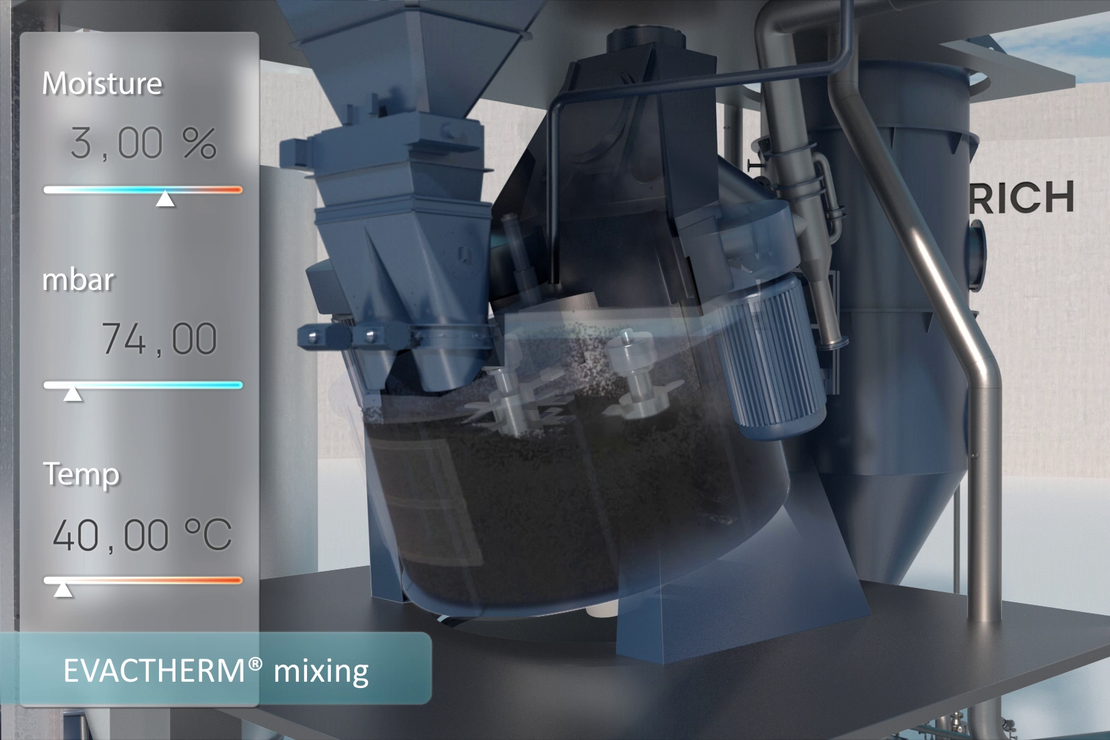
Evactherm
Vacuum and temperature controlled pan. Drying, degassing and reactive mixing in one closed cycle.
Eight processes,
one machine.
A single intensive mixer covers the work that elsewhere takes a line of separate units. Recipe choices, not new equipment.
From gentle folding to severe shear, tuned per recipe.
Build pellets and granules in a single pass.
Pastes, doughs, friction compounds, brake linings.
Break agglomerates into primary particles.
Apply binders and fines onto carrier particles.
Evaporate moisture under vacuum, in cycle.
Down to 10 mbar, degassing while mixing.
Combine heat, vacuum and shear in one pan.
Fifteen
industries,
one
specification.
Bring us
your recipe.
Ship a sample to Hardheim. We will run it on the same intensive mixer geometry your production line will use, and send back a signed protocol with numbers you can take to operations.